What Is Stucco Remediation and How Is It Different From Repair?
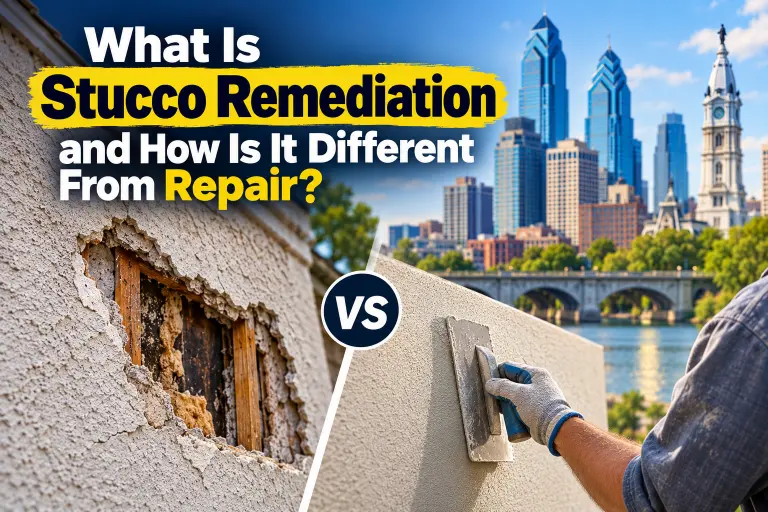
Stucco remediation involves stripping stucco to the wall sheathing, fixing moisture issues causing the damage, and restoring the wall system to exclude water from the building behind the wall surface. Stucco repair is a surface repair that repairs the hole or crack with a visible patch, and the texture is matched. Both options appear to be similar on the outside, and there is a vast difference in the cost, so it’s important to know which one is the one your home needs.
Whether you’re looking at a crack, a soft spot, or a contractor’s estimate that skyrocketed from a few hundred dollars to five figures, this guide helps you understand what is stucco remediation and delves into exactly where that gap comes from.
Stucco Remediation Meaning in Plain Terms
Stucco remediation involves identifying and resolving the root cause of stucco failure, not only the symptom on the stucco surface. The source of failure is nearly always water. A new coat of stucco on top of the old will only delay the inevitable for another season if moisture intrusion has accumulated behind the wall for months or years.
Helpful to remember: repair treats the wound, remediation treats the infection.
Stucco Remediation vs Repair Scope in Practical Terms
| Comparison Factor | Patch Repair | Full Remediation |
| What gets fixed | Only the outer stucco surface | Stucco + building paper + sheathing + framing |
| Addresses the root cause? | No | Yes |
| When it’s typically needed | Small cracks, chips, minor holes, or surface damage | Soft walls, mold smell, water stains, or window leaks |
| How long it takes | Same day to a few days | One to several weeks |
| Risk of the problem returning | High if moisture is still present | Low when done correctly and moisture issues are fully resolved |
| Warranty coverage | Usually limited to cosmetic finish only | Should cover the entire wall assembly |
Need Professional Stucco Repair or Remediation?
Get expert stucco inspection, repair, and remediation services you can trust. Serving homeowners with quality workmanship and long-lasting results.
Get a Free Consultation
Need Professional Stucco Repair or Remediation?
Get expert stucco inspection, repair, and remediation services you can trust. Serving homeowners with quality workmanship and long-lasting results.
Get a Free ConsultationWhen Do You Need Stucco Remediation? Six Warning Signs
Homeowners don’t usually call and request remediation services by name. They call because something seems or feels wrong. These are the signs that indicate when stucco remediation is needed:
- Stucco that remains dark or damp for several days after the rain has ceased.
- Areas near the windows, doors, or foundation line that feel soft and spongy when pressed.
- A strong smell of dampness from inside rooms on an outside wall line.
- Staining, bubbling, or a hollow sound when tapping.
- Swelling or bending window and door sashes.
- A moisture meter reading that is always greater than 20 percent moisture behind the stucco.
Each of them is individually a cause worth investigating. Two or more typically indicate that the wall assembly must be addressed rather than the surface.
Moisture Intrusion: The Root Cause Behind Nearly Every Stucco Failure
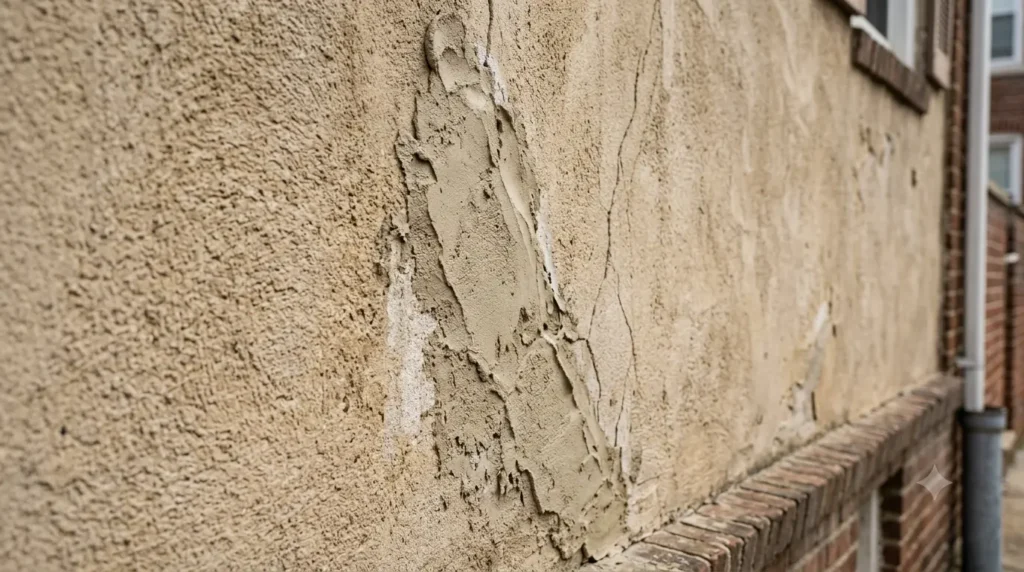
Traditional stucco is a hard, porous material. It is intended to allow a certain amount of water to penetrate and flow through a drainage plane behind the coating. The moment the drainage plane is not in place, is damaged, or was not installed at the base with the right “weep screed,” a moisture intrusion problem arises. The water is then no longer directed towards the ground and instead begins to work on the wood behind the wall.
How Moisture Intrusion Turns Into Sheathing Rot
Fungal decay starts after water has been in contact with wood sheathing for a prolonged period. The sheathing rot starts soft and dark and spreads along the framing until a homeowner notices something on the exterior. By the time damage is visible on the outside of the stucco, it can already be two to three years advanced underneath. The one biggest cause of a patch repair failure on an undiagnosed wall is this lag.
Mold Behind Stucco: The Damage You Cannot See From the Yard
A damp and dark area forms behind the stucco where mold can develop and flourish on the wet wood and paper siding. The first signs are often musty smells, allergy reactions that clear up when people leave the house, or condensation forming on the interior walls in the areas where there is stucco.
No matter what the problem is, if the stucco is removed and mold is discovered, the remediation crew will always stop and treat the moldy area before closing up the wall. Otherwise, sealing over the mold situation turns a job into a much larger IAQ problem.
Why the Philadelphia Region’s Climate Makes This Worse
About 43 inches of rain a year, concentrated from April through October, combined with a humid continental climate that swings between winter freezing and summer humidity. The freeze-thaw action coupled with the constant moisture is particularly damaging to an exterior designed as a wall system with a compromised drainage plane. Stucco issues throughout all of Philadelphia, the Main Line, Bucks, Montgomery, and Delaware counties are similarly exposed to this weather, making moisture-driven issues rather than cosmetic issues across the board.
How EIFS Failure Affects Main Line Homes from the 1985–2005 Era
Exterior Insulation and Finish System (EIFS) is a synthetic stucco appearance constructed over a rigid foam board (insulation) and not a masonry base. It was extensively applied to new construction between 1985 and 2005 on Main Line houses that were being sold with barrier-type EIFS as an exterior that would not require maintenance and would be energy-efficient.
The issue here is that barrier EIFS itself does not have any drainage plan. Water that trickles through a defective sealant joint or a leaky window does not have an escape route, and just accumulates against the sheathing and will rot. It’s for this reason that these homes should be inspected by an EIFS expert before purchasing or selling, and why so many eventually require a full EIFS remediation and not just a patch.
What Full Stucco Remediation Actually Includes
The whole process is disciplined:
- The existing stucco or EIFS should be completely removed back to the structural sheathing.
- Extensive assessment and replacement of any structural sheathing damage, sheathing rot, and/or framing damage.
- If mold is found behind the stucco, it will need to be remediated.
- Installation of continuous proper lapped weather-resistant barrier
- Proper flashing on all window and door openings, roof intersections, and roof penetrations
- Provide drainage planes or rainscreen as needed per current practice.
- Use of the new system of cladding, either in the form of traditional hard-coat stucco or fiber-cement or other durable cladding material
This sequence forms a wall assembly that will control water as presently required by building science. The water that reaches the surface goes outwards rather than into the wood.
Insurance, Warranty, and Hiring: What to Do Next
It is important to remember that standard homeowner’s policies generally do not consider “gradual” water damage and mold as a covered peril but rather as a maintenance problem, so do not expect remediation to be covered without written confirmation from your insurer.
Don’t take a word for it from any contractor and get a warranty from them that covers the wall assembly, not the stucco finish, because a warranty on the finish only will not save you if the sheathing fails underneath. Always ask the contractor for moisture testing before they give you a quote, as it is a guess if they don’t do it.
Frequently Asked Questions
What is the difference between patch repair vs remediation scope?
Stucco repair is used to repair surface cracks or chips when the wall has not been damaged and is still dry. Stucco remediation involves taking down the entire failed system, fixing sheathing rot and any mold found behind the stucco, laying down a proper weather-resistant barrier, and rebuilding the cladding.
When do you need stucco remediation instead of another patch?
Stucco remediation is required if the moisture readings are high during testing, if the stucco is soft or hollow, if previous stucco repairs were unsuccessful, and if moisture has gotten to the interior and caused staining and musty odours.
Does every home with cracks require full remediation?
No. If the substrate is determined to be dry by a crack, and the crack is isolated, it is usually possible to repair the crack. The larger scope is normally used when there is widespread cracking, soft spots, or EIFS failure signs.
How long does a typical stucco remediation project take?
Work typically takes between 2 and 6 weeks once work begins, depending on the number of elevations, weather conditions, and the amount of structural sheathing damage when it is removed.
Is remediation worth the higher upfront cost?
Yes, if moisture intrusion has already led to the development of sheathing rot or mold. Repairs on the surface are more costly in the long run and promote the spread of damage.
Choosing the Right Contractor for the Work
Having experience in failures of both traditional stucco and EIFS is important. The contractor should be able to show a procedure for moisture testing and repair of the substrate along with a procedure for the installation of modern barriers. Written scopes make sure that any damage found once the wall is opened is already accounted for in the contingency, so the homeowner avoids a shock on cost.
Alston Stucco has developed mastery of homes throughout the Philadelphia region, Main Line, Bucks, Montgomery, and Delaware Counties for more than 20 years. This local history involves exposure to the same construction details and climatic stresses as are typical of the locality.