
EIFS Moisture Testing: How Contractors Find Hidden Water Damage
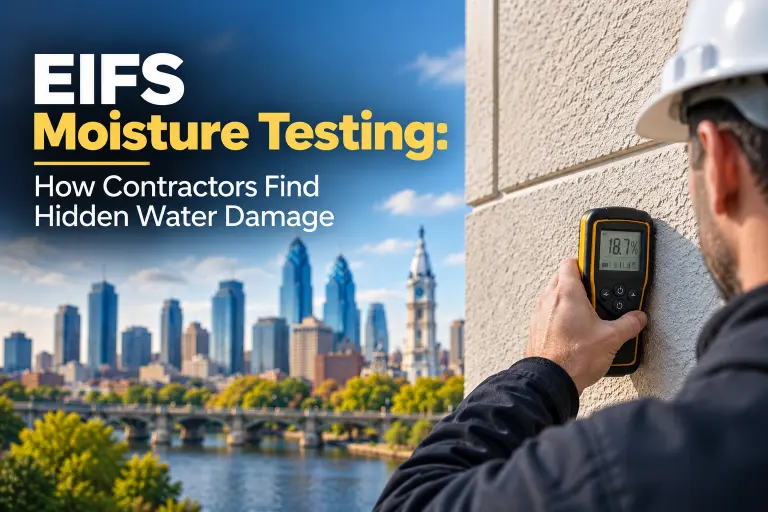
EIFS moisture testing involves visual inspection, probing, and surface scanning. It means making no assumptions about a wall that appears clean on the surface. A house can look freshly painted on the outside and still have gallons of water trapped behind the siding. That’s why a moisture meter stucco inspection is a stand-alone trade and not part of a typical home inspection.
This guide will explain how stucco is tested for moisture, what it is measuring, and what a homeowner should expect from a moisture meter inspection of their stucco home by a Main Line or Bucks County home inspector.
Why EIFS Traps Water That Regular Stucco Sheds
Three-coat stucco is a hard, somewhat breathable cement-based cladding. EIFS is a foam board covered with a thin layer of fiberglass mesh and a flexible acrylic finish coat. That finish coat is nearly waterproof on both sides. When moisture penetrates a broken sealant joint, or if a window wasn’t originally flashed, or a kickout flashing is missing, the water will have no way to escape. It’s installed over the wood sheathing, and the same design that gives EIFS its energy performance also traps moisture that leads to rot once water gets in.
This is a common practice in the industry, and not necessarily a fault of any one manufacturer. Most moisture-related failures in EIFS installations turn out to be issues around windows, doors, or penetrations and not with the EIFS material itself, according to research performed by the EIFS Industry Members Association. Finding that entry point is the first job of a competent inspection.
Why This Matters More in Main Line Homes Built 1985 to 2005
EIFS was popular for use on many homes in Main Line and in greater Philadelphia between 1985 and 2005 when synthetic stucco was aggressively promoted as a good insulator. Many of those systems were “barrier” EIFS, which lacked a drainage plane behind the insulation board. In a case where water enters, there is no way to get it out, and the sheathing remains damp until it is discovered.
Over time, this is aggravated by Philadelphia’s climate. It receives about 41 to 44 inches of rain annually, evenly distributed throughout the year, with approximately 20 inches of snow occurring each winter, which melts and refreezes against exterior walls. Over the years, the freeze-and-thaw action causes hairline cracks in the finish coat and can cause a wall to fail even after it passed the water test five years before.
Need Professional Stucco Repair or Remediation?
Get expert stucco inspection, repair, and remediation services you can trust. Serving homeowners with quality workmanship and long-lasting results.
Get a Free Consultation
Need Professional Stucco Repair or Remediation?
Get expert stucco inspection, repair, and remediation services you can trust. Serving homeowners with quality workmanship and long-lasting results.
Get a Free ConsultationThe Actual Answer: How Is Stucco Tested for Moisture?
A proper inspection does not use a single tool. It is instead composed of three types of testing:
Visual Inspection
Inspecting caulk joints, flashing, and any staining, bubbling, or soft areas in the finish coat where the stucco has been applied and where it meets the ground.
Noninvasive Scanning
To determine the location of moisture throughout the entire wall surface, without cutting any holes.
Invasive Probing
At specific locations indicated by the scan, to verify actual sheathing moisture content behind the cladding.
Invasive tests should be avoided because they are a waste of holes in a mostly dry wall. A hard number is never obtained in the report if you rely solely on noninvasive scanning. It’s used by a contractor who truly understands EIFS, both in sequence and in practice.
Noninvasive Testing: Thermal Imaging and the Tramex Meter
Each hole in a wall built with EIFS needs to be patched and sealed after the work is finished, so it is important to use noninvasive methods for reading moisture.
Thermal Imaging
Thermal imaging involves a surface temperature camera that detects differences in temperature on the surface of the wall. Wet insulation acts differently than dry insulation, and in areas that are wet, the heat signature will be different, particularly a few hours after direct sun or after rain.
- Ideal in the window after sun or rain, when the difference between wet and dry spots is most pronounced.
- Reads the entire wall at one time, useful for targeting the remaining inspection areas.
- This is a screening instrument. It identifies probable wet areas based on temperature, not percentage moisture.
- May be confused by shading, reflective surfaces, or recently painted areas that always cross-check the results with a Tramex reading before any holes are drilled.
The Tramex Meter
The industry-standard noninvasive tool for EIFS is the Tramex meter, in particular the Tramex Wet Wall Detector.
- Performs readings of electrical impedance without any drilling activities in the finish coat and insulation board.
- Identifies high moisture levels at approximately 3 to 4″ depth where most EIFS installations on residential structures are sheathed.
- Provides only a relative reading, not an exact moisture percentage; that is, it gives you an idea of where a moisture problem may be occurring, not how bad it is.
- Walk all the way methodically and mark where it reads wet and mark it up for follow-up.
Invasive Testing: Moisture Probes and What They Confirm
The scanning process indicates a suspect area, and moisture probes determine what is occurring at the substrate. A small pin-type probe is inserted directly into the wood sheathing through a drilled hole that provides a specific percentage moisture content reading instead of a relative moisture content reading.
The only way to get a hard number on the sheathing itself is to use this type of testing, which is important for reporting, insurance, and repair scope discussions.
Invasive vs Non-Invasive Testing at a Glance
| Noninvasive Scanning | Invasive Probing | |
| Tools Used | Infrared camera, Tramex meter | Pin-type moisture probe |
| Damage to Wall | None | Small drilled hole, later patched |
| What it Tells You | Relative moisture, likely wet zones | Exact sheathing moisture percentage |
| Best Used for | Whole wall screening | Confirming specific suspect areas |
| Speed | Fast, whole elevation in minutes | Slower, one spot at a time |
What Sheathing Moisture Content Means
While wood sheathing need not be bone dry, there comes a time when a reading should alter the plan. Based on standard building science guidance, which mirrors what most Level I certified inspectors are trained on, the general ranges are as follows:
| Moisture Reading | What it Typically Indicates |
| Under 16 percent | Normal range for framing lumber, no action needed. |
| 16 to 19 percent | Elevated, worth monitoring or retesting after dry weather. |
| 20 percent and above | Threshold most inspectors use to recommend further invasive investigation, since decay risk rises meaningfully past this point. |
Why an EIFS Testing Report Needs More Than a Pass or Fail
The moisture map of the wall is not only a number, but a usable testing report. This includes photographs of all the probe sites, readings at each of the sites, thermal images (if any), and a clear description of the likely entry point, whether sealant joint failure, missing kickout flashing, or a terminated below-grade condition. If a homeowner later needs to use the report in an insurance claim or to obtain bids from more than one contractor, then it is useful.
What Level I/II EIFS Inspector Certification Actually Covers
There are cases where the damage isn’t caught, even by the most experienced home inspector or contractor, because the home inspector has not been properly trained on how to read the EIFS. Most often held by a Level I EIFS inspector, the certification from the Exterior Design Institute involves EIFS system components, drainage design, moisture analysis, and inspection procedures.
The Level II certification expands on this to include more comprehensive building envelope examination of all building envelopes, including stucco, masonry, and other claddings. The difference between the contractor who sees EIFS as a system, as opposed to just a surface, is the ability to trace the actual site of the leak versus just applying a patch where water is seen.
Common Mistakes Homeowners Should Watch For
- Using a contractor who is not trained or equipped to perform EIFS work.
- Skipping a written report because the wall “looks fine” from the outside.
- Taking a contractor’s word for it, with no reading or photo evidence.
- If the exterior is painted or recaulked, assuming it means that the moisture problem underneath was taken care of.
- Not testing before the home sale and only revealing it during the buyer’s inspection.
What Happens After Testing Confirms Moisture
If the invasive readings remain high, the next step is to scope depending on the distance the moisture has travelled. A particular reading at one window might just necessitate a specific treatment on that particular flashing element. If there are elevated readings throughout the sheathing, it is likely a patch is not sufficient, and it may be a sign of a remediation project. Whatever the case may be, obtain the written report before finalizing the scope of repair, and seek second opinions if the scope of repair is a complete removal.
Frequently Asked Questions
How to test for moisture in stucco?
Stucco and EIFS are first tested using non-invasive moisture measuring tools like a Tramex meter and thermal imaging, and secondly with invasive moisture measuring probes that penetrate the sheathing and return actual moisture content percentages.
What are the differences between invasive tests and non-invasive tests?
Non-invasive methods are scans that do not involve holes. Invasive is a method that involves drilling small holes and inserting probes to determine moisture content in the sheathing and firmness of the substrate at the site.
Is a Tramex meter reading enough to prove water damage?
No. A Tramex meter or other scanner displays moisture as a relative measurement, useful for identifying where to probe. Only invasive readings into the sheathing confirm actual moisture conditions.
What is a high moisture content for EIFS sheathing?
Readings of over about 20 percent should be taken seriously, since decay risk rises meaningfully past this point. The scale for gypsum sheathing is different.
Who can do the EIFS moisture testing?
A Level 1 or Level 2 EIFS inspector with calibrated meters, who records results in a clear testing report and has an understanding of regional construction practices as they relate to the Main Line and surrounding counties.
Get Your Walls Tested Before It Becomes a Bigger Problem
When your home has EIFS but has not been professionally tested, there’s no warning of concealed moisture until repair expenses have increased. Alston Stucco can scan, probe, and provide a complete written report that you can take action on. Call today to schedule an inspection.