Signs Your EIFS or Synthetic Stucco Home May Have Hidden Moisture Damage
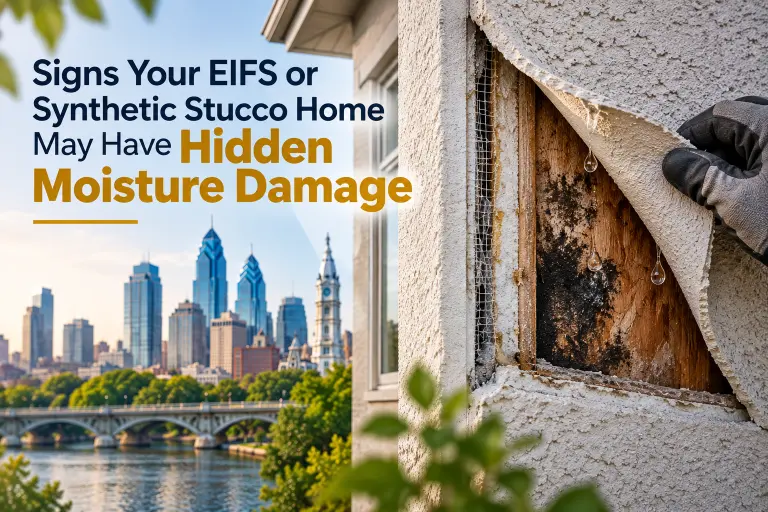
If your home was constructed between 1985 and 2005 and has stuccoed walls, your home might have an exterior Finisher Stucco System or EIFS (also referred to as synthetic stucco. EIFS is a face-sealed building system that relies on proper caulking, flashing, and sealants to prevent moisture from entering, as opposed to traditional stucco. Once the seals start to fail, water may accumulate behind the wall. When moisture damage is seen on the outside, months or years of water intrusion problems may have occurred in the sheathing and framing underneath the wall.
Staining or discoloration of the exterior finish, soft or spongy spots upon touching the exterior wall, musty odors near exterior walls, bubbling or cracking at trim and flashing joints, and gaps in trim and flashing joints are all common EIFS moisture damage signs. This blog will tell you what you need to know, why some EIFS homes are particularly susceptible to hidden water leakage, and what an EIFS home inspection includes.
What Is EIFS and Why It Behaves Differently Than Traditional Stucco
EIFS is an exterior wall assembly with multiple layers of foam insulation board, reinforced base coat, and thin, paintable finish coat that is mounted over the sheathing of a house. Traditional hard-coat stucco is a cement-based material that is applied over a moisture barrier and metal lath. Contrary to EIFS, conventional stucco can handle moisture contact since the cementitious material can dry and the wall assembly is engineered to shed moisture.
The face-sealed EIFS is sometimes referred to as any original EIFS installed prior to the mid-1990s where there is no drainage plane behind the original EIFS. It takes just minutes for water to drip onto the deck below if it gets through a crack or into a nail hole in the roof, or if a joint is not sealed properly. There is potential for water to become held up in the wall assembly and affect the wood sheathing and framing.
This is why moisture damage in synthetic stucco might occur long after the original leak. The outer finish might look fine, and the sheathing under it may be soft or decayed.
Face-Sealed EIFS: Why Older Systems Carry the Most Risk
Sealant joints at windows, doors, rooflines, deck ledgers, and utility penetrations are critical to the success of face-sealed EIFS. Sealant will not last forever. Caulk can shrink, crack, and pull away from its surrounding surfaces over time, often within the first 5–10 years of use, before many homeowners realize the need to have it inspected or replaced.
The failure of a joint can allow water to enter the wall cavity and may not offer good opportunities to drain and/or dry. Water-related issues with EIFS on residences nationwide resulted in litigation and modifications of EIFS design and installation. These are known as “drainable EIFS” and contain a water-resistive barrier and drainage area behind the cladding. The face-sealed system risk evaluation is one of the reasons why the age and construction information of an EIFS system is important.
Need Professional Stucco Repair or Remediation?
Get expert stucco inspection, repair, and remediation services you can trust. Serving homeowners with quality workmanship and long-lasting results.
Get a Free Consultation
Need Professional Stucco Repair or Remediation?
Get expert stucco inspection, repair, and remediation services you can trust. Serving homeowners with quality workmanship and long-lasting results.
Get a Free ConsultationWhy Main Line PA and Bucks County Homes Built 1985 to 2005 Face Higher Risk
From the mid-1980s to the mid-2000s, EIFS was extensively promoted and used on high-end EIFS-era homes on the Main Line, PA, and Bucks County. That does not mean there is a problem if your home was built at this time and you still have the original synthetic finish. But it might be worthwhile to find out if the type of EIFS system applied has been properly maintained or if the sealants and flashing details have been maintained properly.
Sealant joints around the homes in Bucks, Montgomery, and Delaware Counties face freeze-thaw conditions, humid summers, and wind-driven rain. These conditions can cause sealants and other surface parts to degrade with age.
The Core Visible Warning Signs
| Sign | What It Looks Like | Where to Check First |
| Surface Discoloration | Dark, brown, or gray streaks running down the finish, most often under openings | Directly beneath every windowsill and door head |
| Spongy or Yielding Areas | The wall surface compresses slightly or feels soft under firm knuckle pressure | Lower wall sections, outside corners and deck ledger zones |
| Persistent Damp Smell | An earthy, musty scent that lingers indoors along exterior walls | Rooms whose exterior walls are finished in EIFS |
| Cracked or Raised Bubbles | Fine cracks spreading from window corners or sections of finish that have lifted | Perimeter of all windows and doors |
| Failed or Open Sealant | Caulk that has shrunk, cracked, or separated from frames and trim | Every penetration, including vents, pipes, and fixtures |
Soft Spots: What They Actually Mean
A noticeably soft or yielding area deserves further investigation. Because EIFS contains a relatively soft insulation layer, pressing on the finish alone cannot confirm whether the sheathing or framing underneath is damaged.
Moisture testing and targeted investigation are needed to determine the condition of the wall assembly. Soft spots can occur near failed sealant joints, flashing problems, or other points of water entry.
Staining and Discoloration Patterns That Signal Ongoing Intrusion
One of the most easily overlooked synthetic stucco water damage signs is staining that appears to be normal dirt or weathering. The difference is often where the staining occurs and how it is shaped.
General dirt streaking is often relatively consistent across a wall surface and follows the direction of rainwater runoff. Moisture-related staining may be concentrated directly below a window, door, or roof-to-wall interface and may indicate a localized water-entry problem.
Musty Odor and Interior Clues Homeowners Often Miss
If a musty smell is detected along an interior wall, especially when there is no apparent cause of moisture, it may require further investigation for possible hidden water intrusion.
A face-sealed application may allow water to penetrate the sheathing and cause mold growth or deterioration to progress in the building envelope without visible staining on the outside. You should still have an EIFS moisture inspection if there is an unexplainable smell, but the exterior of your house appears clean,
Is My EIFS Home Damaged? A Simple Way to Think About Risk
Ask three questions:
- Was the original EIFS coating applied to the home, especially if built between 1985 and 2005?
- Has a window, door, or trim not been checked or caulked in the last 5 years?
- Are there any visible stains, cracks, soft spots, or musty smells on the outside EIFS wall?
When two or more of these questions are answered “Yes,” it is a good reason to consider hiring a professional home inspector or EIFS specialist rather than waiting for more obvious damage to appear.
What a Professional EIFS Home Inspection Actually Involves
A proper inspection is more than a visual walk-around of the exterior. It typically includes:
- Exterior examination of sealant joints, flashing details, and finish-coat condition.
- Moisture-meter readings at a grid of locations throughout each wall, especially below windows and around corners.
- Surface moisture readings at a limited number of locations where there is an indication of elevated moisture, to help evaluate the condition of the sheathing.
- A written report documenting moisture readings, visual defects, and recommended next steps.
Unlike a general home inspection, a specialized EIFS moisture evaluation can help identify potential moisture issues behind a wall that appears intact from the exterior.
Cost, Timeline, and What Happens Next
Remediation may include removal of the damaged area of EIFS, replacement of damaged sheathing, repair of the flashing detail that allowed water to enter the wall assembly, and installation of the appropriate wall assembly. Depending on the circumstances, this may include an upgraded assembly designed to provide drainage.
The extent of the damage and cost will depend on how far deterioration has progressed. This is why identifying potential moisture problems when soft spots or staining first appear can help homeowners address issues before they become more extensive.
Frequently Asked Questions
What are the earliest EIFS moisture damage signs a homeowner can check?
Some of the first practical signs may include soft or yielding areas, dark stains beneath windows, and a persistent musty smell around exterior walls.
How do I know if my EIFS home is damaged if the exterior looks fine?
Does not automatically mean that the wall assembly is structurally sound and not damaged by moisture. Moisture can be assessed in areas that cannot be assessed from the surface alone by using a professional moisture assessment that may involve moisture-meter or probe testing.
Why are homes built from 1985 to 2005 more vulnerable?
A few houses were built during this time using barrier-type EIFS, with no barrier drainage features. The risk of concealed moisture intrusion is influenced by the type of EIFS assembly, installation information, maintenance records, and status of sealants and flashing.
Can window and door flashing failure cause damage even without large cracks?
Yes. Water can enter at common failure points such as deteriorated sealant, improperly detailed flashing, or other openings even when the main field of the wall remains intact.
When should I schedule an EIFS home inspection?
Consider scheduling an inspection if the house was built between 1985 and 2005, if there are soft spots or staining, or if the property has not had a specialized EIFS moisture evaluation in several years.
Protecting the Structure Starts with Clear Information
Homeowners have the opportunity to deal with the issue before it progresses into a larger problem when the EIFS shows signs of possible moisture intrusion. In face-sealed systems, the signs of moisture damage in EIFS that should be addressed are soft spots, staining, musty odors, and window or door flashing issues.
A professional moisture assessment can give a more comprehensive understanding of the wall assembly and can decide what the next steps are for your home. Contact Alston Stucco for a professional home evaluation for Southeastern Pennsylvania homes.